

A colleague said something to me recently while we were talking about how to manage the tension between tasks that have to get done and the real strategic work that needs space. I presented her with something that sounded like:
I lose something if I give this up. And she asked me:
"Ok, fair. But what do you gain?"
And that unlocked a new perspective I didn't know I needed. So I'm going to use that here.
I’ve been the in-house biller.
I think that's important to say before I make an argument about managed billing.
I've sat on that side of the table. It's how I got good at this.
Being on the provider side taught me things about revenue cycle management that I don't think I could have learned any other way. You learn your organization in a way an outsider simply can't. You know the history behind the weird workflow. You know which problems aren't really billing problems. You know when the denial sitting in front of you is actually a documentation problem, a credentialing problem, an operations problem—or the downstream evidence of a decision somebody made six months ago.
That knowledge is extraordinarily valuable.
And talking to more providers about their experiences is how I got better.
Because eventually I realized something: everyone is paying for RCM expertise. The question is what you're paying for. Are you paying for learning? Or are you paying for optimization?
Build internally, and you finance the learning curve
- A payer changes a rule. Your team learns it.
- You add a service. Your team learns it.
- You enter a new state. Your team learns it.
- You hire someone who knows Medicaid beautifully but hasn't worked much with your commercial payers. They learn them.
- Someone leaves. Someone else learns what they knew.
That's not an indictment of internal billing. That's the cost of building expertise.
A sophisticated managed RCM operation should be selling you something different. Not more people touching claims. Access to learning that has already happened—and continues to happen across an ecosystem larger than your own.
The weird denial you encounter on Tuesday might be something we've already seen somewhere else on Monday.
That's the difference.
Which brings me to activity.
Healthcare has spent years slowly confronting an uncomfortable question: why are we paying for activity instead of outcomes? We see it in the continued movement away from pure fee-for-service reimbursement and toward value-based arrangements. Because eventually somebody asks the obvious question: did all of that activity actually accomplish anything?
So I think it's worth asking the same question about RCM.
If I employ someone for forty hours this week, I have purchased forty hours. Maybe those forty hours resulted in clean claims, faster payment, problems caught upstream, payer trends identified early, and fewer preventable denials. I hope they did. But the economic arrangement itself doesn't require that outcome. The paycheck is the same.
This is part of what makes percentage-based managed billing interesting to me. The incentives can move closer together.
If you don't get paid, neither do we. Suddenly I care quite a lot about why you aren't getting paid. Not just whether somebody touched the claim.
Activity matters. Outcomes matter more. Which, incidentally, is something healthcare seems to be figuring out everywhere else too.
Now, managed billing has earned some of its reputation.
Let's talk about the trauma of managed billing gone poorly. Because I talk to providers. And some of you have stories.
You outsourced billing because someone told you it would make your life easier. Then your account manager disappeared. Nobody could tell you what was happening with your AR. You got a beautiful report every month telling you everything was fine while everything was very much not fine. Claims were being "worked." Tickets were being "resolved." Meetings were happening. Activity everywhere. Money? Different conversation.
So when someone tells me they tried managed billing once and would never do it again, I'm not going to tell them they're wrong. I'm curious. What happened?
Because outsourcing responsibility for the work does not mean outsourcing responsibility for your business. It's still your revenue. Your patients. Your compliance exposure. Your payer relationships. Your license.
You should be suspicious of anyone asking you to hand them that responsibility without letting you see behind the curtain.
Which raises a much more useful question than "Should I outsource?" How do you know whether an RCM company is actually the real deal?
Like Paul Wall, I'm the people's champ.
So tell me. You're shopping. What makes it look good? A slick website? Testimonials? A 98% clean-claim rate with an asterisk somewhere explaining what "clean" means? I'm less interested.
I want to know how the thing actually runs. And there is a surprisingly easy way to take a peek behind the curtain.
Look at who they're hiring.
Seriously. Go look at the jobs. What RCM roles does the company employ? What do those roles actually do? What kind of experience do they require? Where are they located? Are there people whose job is to understand payer behavior? Denials? Credentialing? Analytics? Operations?
Are you seeing actual revenue-cycle expertise inside the organization you're trusting with your revenue cycle? Or are you seeing layers of account management between you and…something else?
Because if I outsource my billing to you and you outsource my outsourced billing—I'm paused. Are you?
But internal billing has a superpower managed billing doesn't.
Your biller knows you. Don't underestimate that.
They know that the new clinician didn't understand the documentation requirement during onboarding. They know that somebody changed a workflow three weeks ago. They know why that authorization isn't where it's supposed to be. They know which operational problem keeps masquerading as a billing problem.
That is institutional knowledge.
And despite being the person currently selling managed RCM services, I don't think the obvious answer is: get rid of that person. Quite the opposite.
I think we have spent too much time treating this as a binary decision. In-house. Or outsourced. Pick one.
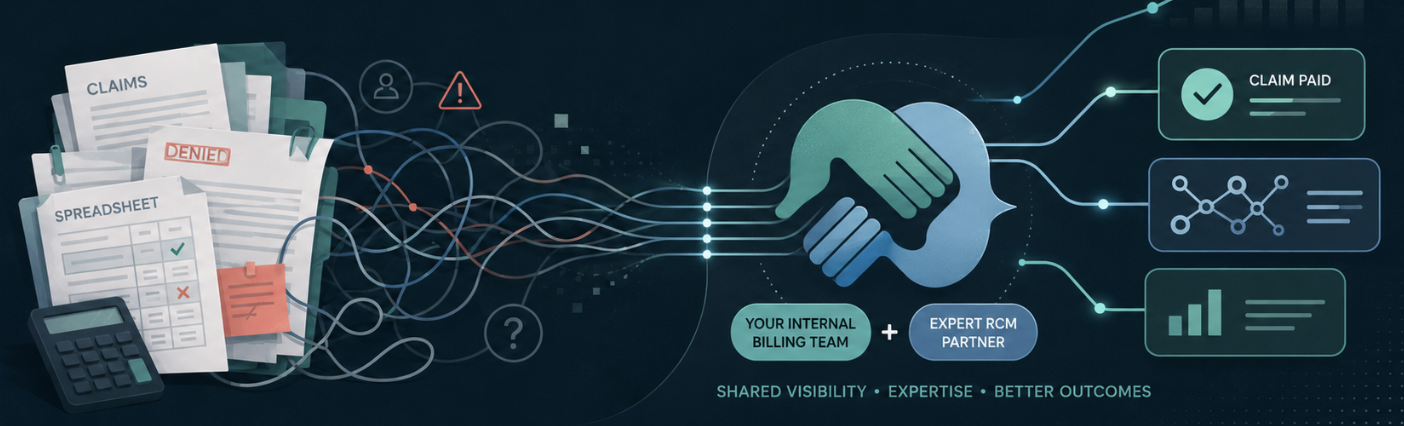
But what if your internal biller didn't have to be your payer-policy department, denial analyst, clearinghouse expert, credentialing researcher, reimbursement strategist and claims department simultaneously? What if they could stay close to your organization and use information coming from a much larger RCM operation to make your organization better?
Now allow me to introduce a concept involving a piece of cake. One you can have. And eat too.
Your biller can stay.
This is one of the things I find particularly interesting about what we're building at Noteable.
Elite isn't designed around the assumption that your organization hands us the keys and disappears. It's designed to work with you. And yes—that can include your internal biller.
The information doesn't have to stop at our team. Your biller can be the person at the other end. They can see the insights we're seeing. Understand what's happening. Bring it back to your clinicians and operational teams. Identify the thing inside the organization that produced the revenue-cycle problem in the first place.
Because I have never been particularly interested in fixing the same denial forever.
Fix the system, not the symptom.
That's where the internal person becomes incredibly powerful. They bring the institutional knowledge. We bring the pattern recognition, tooling, payer intelligence, specialized expertise, and visibility that comes from working across an ecosystem.
And somewhere in the middle, you stop asking whether billing is "in-house" or "outsourced." It's just your revenue cycle. Working the way it's supposed to.
That's the part I care about.
We're not doing RCM here at Noteable because the market says EHR companies should add RCM. And I genuinely don't believe RCM needs another vibe-coded tool promising to revolutionize healthcare because someone discovered claims have a 837 file format. We need durable, operationally sophisticated solutions. Built by people who understand that revenue cycle problems don't politely remain inside the revenue cycle.
They're clinical. They're operational. They're technical. They're regulatory. They're human.
So our approach is person-centered because the system itself is made of people.
You become part of our ecosystem. We become part of yours.
That's partnership in practice.
But the real way to settle the in-house versus managed billing conversation?
Talk.
Tell me what you're doing. Tell me what's working. Tell me what went spectacularly wrong the last time you outsourced it. Tell me why your internal biller is worth their weight in gold. Tell me the thing about your payer that makes absolutely no sense.
My most valuable insights have always come from conversations with providers doing this work in the real world. That's how I got good. It's still how I get better.
So yes.
Outsourcing your billing sounds like losing.
But what do you gain?
Figure that out first. Everything else is math.